
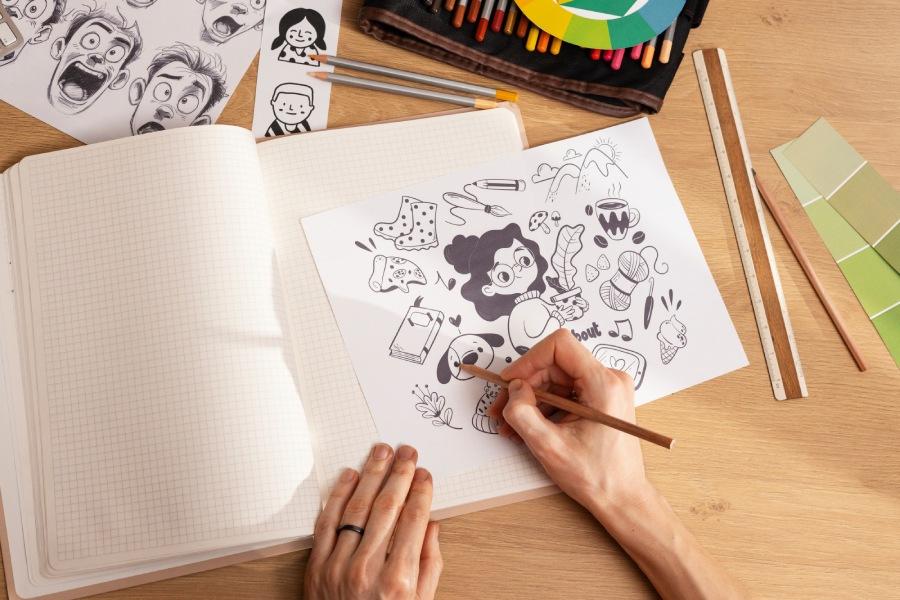
“Struggling with stiff anime poses or wonky proportions? Discover simple anime anatomy drawing tips for beginners, from head scales to dynamic poses!”
Ever felt super annoyed while sketching your favorite character, only to realize their body proportions look totally off? One arm is weirdly longer than the other, the shoulders look stiffer than a cardboard box, or the head is oversized like a giant melon?
If you've ever experienced this horror story, welcome to the club! Searching for actionable anime anatomy drawing tips is the ultimate first step to breaking free from the curse of "wonky proportions."
Let's be real—anatomy is easily the scariest nightmare for almost every beginner illustrator, otaku, or aspiring artist learning how to draw anime characters.
But don't panic just yet! Mastering anime body proportions isn't some dark magic reserved exclusively for naturally gifted artists.
With a fun mindset and solid foundational knowledge, you can easily make your favorite OC look balanced, dynamic, and aesthetic.
Let's break down the ultimate guide below!
1. Master the Core Foundations of Anime Body Proportions
Before you jump straight into complex action poses or dramatic clothing folds, the first essential skill to master is understanding baseline anatomy measurements.
In the world of anime art, the ultimate trick for quick body measurement relies on a single unit: the head scale.
The Head Scale Guideline for Different
Art Styles The head size is the most universal rule of thumb for determining your character's height and ideal proportion when you draw:
Proportional / Standard Style (6 – 7.5 Heads): Perfect for teens and adult characters with a realistic look, typical of shounen or slice-of-life genres.
Heroic / Elegant Style (8 Heads): Great for tall characters, fashion models, or imposing fighters.
Chibi / Super-Deformed Style (2 – 3 Heads): The ideal choice if you want to create a super cute, funny, and tiny version of your favorite idol.
Use Basic Geometrical Shapes (Mannequin Construction)
Don't jump straight into drawing detailed outer contours! Start your sketch by stacking basic 3D geometric shapes: spheres for the head, cylinders for arms and legs, and blocks or trapezoids for the chest and pelvis.
This mannequin method makes it infinitely easier to visualize body volume before moving on to clean lineart.
2. Secrets to Drawing Dynamic Anime Body Structures
Have you ever looked at your finished art and felt like the character looks as stiff as a mannequin in a shop window?
Pro Tip for Dynamic Poses: Always draw a line of action (the main sweeping curve of movement) before building the torso. This line breathes life and momentum into your character's pose!
Tricks for Head, Shoulder, and Torso Anatomy
The chest and shoulder structure dictate a character's core vibe. For male characters, draw wider shoulders with sharper angles to give a grounded, sturdy feel.
For female characters, keep the shoulder slope softer, make the ribcage slightly narrower than the hips, and give the neck a slightly more slender curve.
Master Gesture Lines and Dynamic Poses
To keep your anime characters from looking robotically stiff, avoid drawing perfectly symmetrical, vertical standing poses. Tilt the shoulder and hip lines slightly in opposite directions (a technique known as contrapposto).
This simple trick instantly makes your character look natural, fluid, and alive whenever you draw.
3. Routine Practice and Real-Life Reference Exploration
Mastering these anime anatomy drawing tips won't happen overnight. Your hands and brain need time to build muscle memory through consistent, targeted practice routines.
Gesture Sketching: Quick Sketches (30–60 Seconds) for loosens up hand movement & captures fast action.
Reference Study: Real Photos / 3D Mannequins for understanding muscle placement & real perspective.
Trace & Deconstruct: Deconstructing Pro Artist Work as a learning guide of how professionals simplify human anatomy.
Use Real Human Photos and 3D Models as References
Many beginners fall into the trap of only studying from other stylized anime drawings. However, the best way to understand anatomy is by studying real human photo references first!
You can also use 3D pose apps like Clip Studio Paint or Easy Poser to visualize tricky perspective angles.
The Trace and Deconstruct Learning Method
Hold up—don't get it twisted! Tracing art to claim it as your own is definitely a big no-no. But tracing for structural analysis building skeletal lines over your favorite artist's work is an amazingly effective study method.
This exercise helps you break down how pros simplify complex muscle groups into sleek, aesthetic lines.
Consistency is the Real Secret to Mastering Anatomy!
At the end of the day, learning anime anatomy drawing tips is an exploratory journey that takes time and patience. Don't feel discouraged if your current sketches still look a bit lopsided or wonky.
Every single master illustrator whose work you admire today started out drawing weird-looking proportions, too!
Conclusion
The ultimate key is to keep practicing, embrace your mistakes, and enjoy every pen stroke along the way. Grab your pencil or stylus, open up a fresh canvas, and start trying to draw your dream character today!